
No products


No more blisters thanks to our patented yarn
Do you plan to tackle large altitude differences in ski mountaineering?
Our anti-blister socks use a patented merino wool and polypropylene yarn that prevents the formation of blisters
A sock can avoid the formation of blisters?
A sock designed specifically to prevent the risk of blisters can contribute significantly in preventing its formation!
Let's see in detail what are the features of our extra fine merino socks without mulesing that make them the best anti-blister trekking socks and socks anti-blister running shoes currently available on the market and why.
Shock absorbing pads:
If the main cause of blistering is excessive pressure of a portion of the shoe on the skin, the first thing a sock must do is protect the foot in the most important points urged.
Our anti-blister socks are reinforced through a double-processed sponging in all the points of greatest stress on the foot: heel, front sole (the joint between metatarsal and phalanges) and the shin in the case of ski and ski mountaineering socks.
 the stress points on the foot
- A Points of greatest stress during Running
- B Points of greatest stress during Trekking
- C Points of greatest stress during Ski Mountaineering
Our sponging, unlike that of our competitors, is made with the same high quality merinos yarn and not with polyamide (known in jargon as “filanca”).
The advantage is to have all the advantages of the technical merino wool yarn in contact with the foot and not the polyamide which is a synthetic yarn that serves to give structure and resistance to the sock but which maintains humidity.
Why is it shall we do it?
We do it because it makes no sense to make merino wool socks if we then put polyamide in contact with the skin which keeps the foot moist, increasing the risk of the formation of bubbles and blisters and contributing to the proliferation of bacteria and bad smells.
But then why do the manufacturers of anti-blister socks use polyamide sponging?
If you're wondering why? our competitors make sponging in polyamidethe answer is; simple: because polyamide is a material infinitely less expensive than merino wool and thanks to its resistance and slipperiness; it causes the machinery to jam very rarely, significantly reducing times and costs during the production phase!
We prefer to reduce profit margins but provide better socks from a technical, quality point of view and comfort!
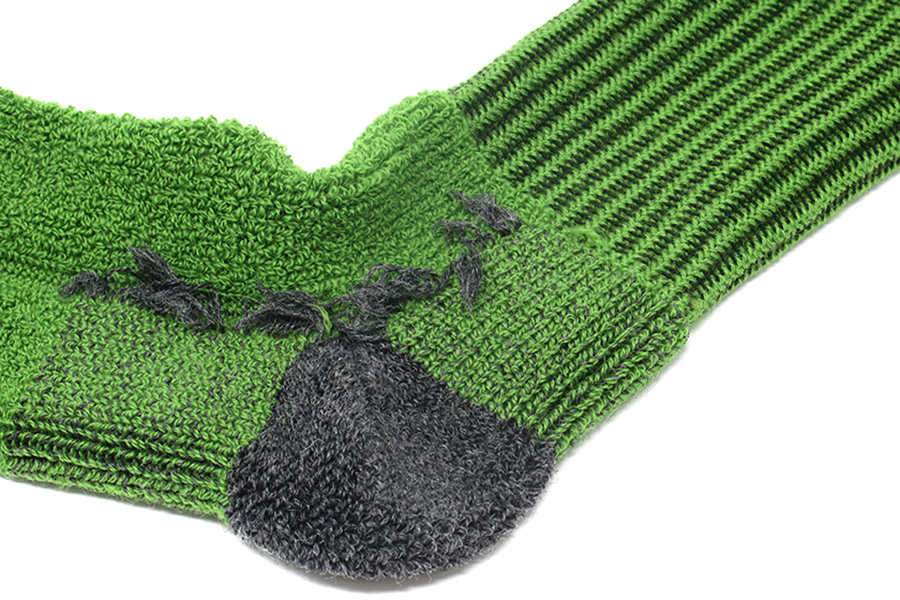 detail of the sponging in the 100% organic merino trekking socks
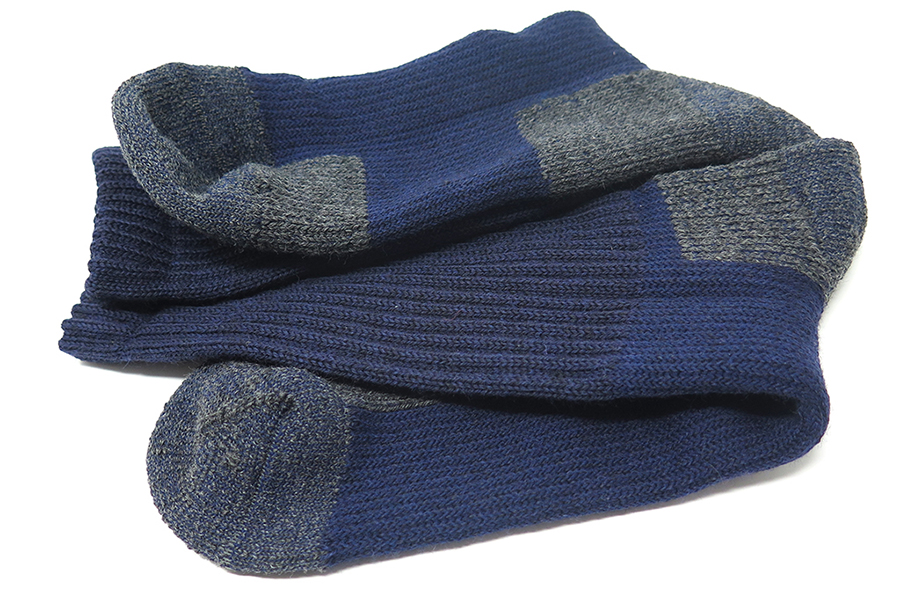 anti-blister trekking socks in functional merino, detail of the external finishes
The NATURE LINE socks are aimed at a public that is more attentive to environmental issues and the health of animals and consumers. The wool used is an extra fine Merino wool certified GOTS (Global Organic Textile Standard). This makes it a truly quality product. superior however 100% wool is undoubtedly more delicate of synthetic yarns and therefore to increase their durability and resistance, we made the pads on the toe, malleolus and heel with a thicker yarn. resistant that has only 40% merino. It is a patented yarn!
]
The GOTS certification is a certification that is issued on a specific product. This certification allows the release of a logo and must be accompanied by a unique number indicating that product. Beware of counterfeits!
High Quality Materials:
If the second cause of the formation of blisters is humidity and heat, it is precisely these two elements that must be counteracted inside the shoe and in contact with the foot.
Merino wool protects from cold and humidity. which cause the spread of rheumatic and arthritic diseases in general, moreover, it is an effective natural therapeutic remedy in case of inflammation and pain thanks to the presence of lanolin within its fibres. It does not irritate the skin and protects against bad odors thanks to its nourishing properties. natural antibacterial.
Extra Fine Merino Wool
The choice of extra fine merino wool for all our anti-blister socks allows us to naturally combat overheating of the foot and moisture retention.
Merino wool has the particularity of to be a hydro-regulator and an excellent thermal insulator.
Sweating is one of the physiological methods our body uses to balance the loss and gain of heat (thermoregulation). This, however, can lead to the formation of vesicles; but thanks to our high-quality materials, this risk is significantly reduced.The merino yarn absorbs moisture in excess of up to 40% of its weight, quickly releasing it in contact with the air. This characteristic combined with the transversal density bands reduced which increase breathability of the sock, allows the foot to maintain moisture controlled by avoiding overheating (always provided that the shoe is also breathable).
Patented technical yarns:
The one used in our anti-blister socks is a patented yarn made of 60% extra fine merino wool and 40% polypropylene wrapped in a braid.
This extremely durable braided yarn has two key blister prevention features that make it unique:
- humidity is moved towards the outside of the sock and dries even more. quickly, always ensuring maximum breathability and protecting the foot from the accumulation of moisture. which weaken the epidermis
- The punctual heating due to excessive friction is dissipated very quickly, preventing the most sensitive areas from overheating. stressed and preventing the formation of bubbles and blisters.
Lanolin
Lanolin is a waxy substance, also called "wool wax", which is naturally produced by the sheep and which is deposited on the coat, carrying out a protective action and preserving the animal's skin from dehydration, abrasions and irritation. It is therefore a substance with properties emollient, hydrating and healing.
Our yarns release this substance, albeit in minimal quantities, contributing to the prevention of the phenomenon of bubbles and blisters.
[/box_in_evidenza]]Here's why that of merino wool is the best choice right! This incredible material combines the advantages of a natural recyclable and biodegradable product with the very high technicality necessary for outdoor clothing.
[/box_in_evidenza]
Almost 35% of the microplastics present in the sea come from synthetic clothing fibres, but on the contrary, natural fibers such as wool biodegrade easily, offering a solution with a lower environmental impact.
The thickness of the anti-blister socks
Our anti-blister socks in merino wool can be very thick or not very thick but we do not make thin socks > why in our opinion, to ensure maximum protection and maximum comfort of the foot, it is It is necessary to have a certain amount of material to work with.
The foot undergoes volume fluctuations due to temperature and therefore the shoe can be more or less tight throughout the day as it is much less elastic than the foot.
The task of a technical sock is to that of gradually compensating for these variations, always ensuring maximum precision in the fit.
.... a very thin sock is unable to ensure this compensation and loses functionality. entrusting comfort solely to the manufacturing of the shoe
Furthermore, the thickness of the best trekking socks also solves the problem of seams. In fact, many people are bothered by the seams of the sock which touch the top of the toes and can cause annoying friction.
The handmade stitching of our socks is always hand-stitched downwards, it tends to disappear inside the wool sponging so as not to create friction or annoying blisters. Through this trick we are able to create a seamless trekking sock without having to resort to special knitting machinery that is usually used in the production of ultra-technical healthcare products!
Unfortunately, if you are reading this post you know what blisters are and you will have understood that with socks like ours it is can significantly reduce the risk of blisters.
 trekking socks from the TECH line which ensure greater resistance and greater protection against the formation of blisters
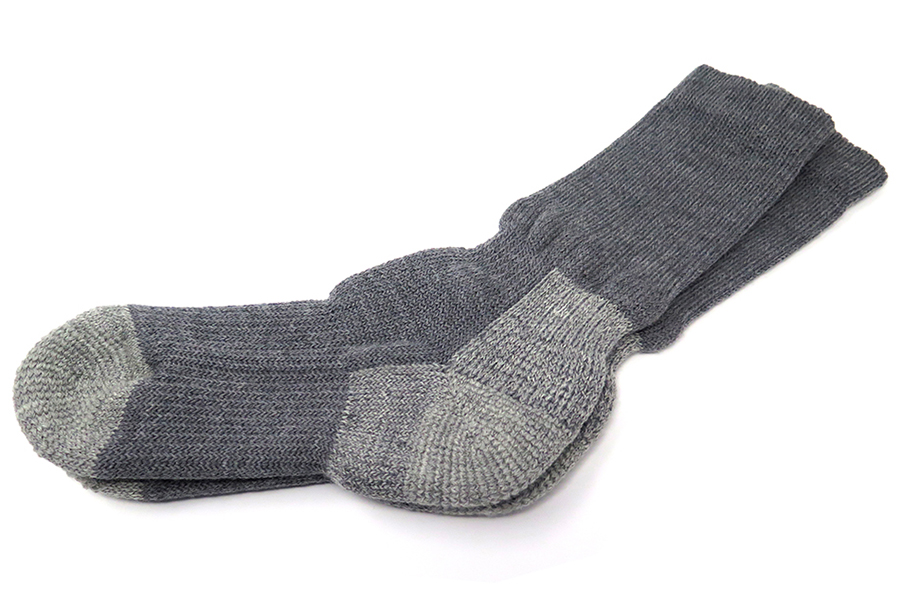 socks for Hiking in 100% merino wool reinforced for warmth and maximum comfort
Blisters on the feet: what to do? Advice and remedies
Have you returned from a trekking excursion and your feet are asking for help? With our anti-blister trekking socks in merino wool this won't happen!
These are the tips you wish you had known before wearing our socks!
- Disinfect the bladder with a disinfectant
- Equip yourself with a disposable syringe
- Practice one or more holes at the edge of the blister or blister
- Use gauze to apply light but constant pressure on the roof of the blister or bubble until the liquid is everything came out and the bubble disappeared. glued to the skin.
- Disinfect again and cover everything with protective gauze held by a ribbon plaster or tubular mesh gauze.
- The skin that formed the roof of the bubble will remain. as a natural dressing for approximately 3 days
- Later you can be removed and the underlying skin should be dressed with a healing ointment
It is essential that the bladder remains clean once opened because it is the risk of becoming infected is very high, especially during long treks where the foot remains closed inside the shoe all day (which is a humid environment that does not facilitate healing)
Remember that blisters should not be neglected, otherwise they may take longer to heal. days than normal and is However, it is important to understand the causes of blistering to take the necessary precautions especially before buying socks and shoes for your activities. outdoor.
Why do blisters form?
Blisters can form very quickly, causing a burning sensation and can be very painful, significantly reducing your endurance and your performance or in any case significantly reducing the pleasure of your excursion. On the foot, blisters develop due to excessive pressure or continuous friction exerted against a particularly sensitive and exposed portion of skin.
At parity of stress on the skin, blisters form more easily on damp skin and in the hot season because it is the increase in temperature contributes to the weakening of the skin.
In detail what happens is that the skin is stressed by friction, overheats and reddens. If friction and stress is If prolonged enough, the separation of the epidermis (the outermost layer of the skin) from the lower layers follows and serum comes out from the capillaries and accumulates under the skin, forming a transparent bubble.
The blister therefore arises for protect the inflamed skin from further pressure and safeguard the lower layers of the skin.
How to prevent foot blisters with anti-blister socks
Blisters on the feet of mechanical origin can be prevented with simple good habits:
- Wear good quality shoes, suitable for your foot and breathable;
- Buy shoes in your size, avoiding both those that are too tight and those that are too loose;
- Purchasing shoes by trying them on with the socks you will use;
- In the case of new shoes it is It's best to wear them first for simple walks before leaving for long treks;
- Use our merino wool trekking socks;
- Maintain the hygiene of your feet and always dry them very well after washing them;
Many argue that it is important to apply an emollient cream on the foot before trekking and then the debate opens on the type of emollient to use, whether Vaseline or other natural products is better.
Personally I don't ; I think it's a good idea. In the evening after trekking, wash and care for your foot, possibly using an emollient cream although letting your foot breathe in the air is always the best thing to do. Before trekking it is better not to wear anything because it the skin will go to heat up, to get damp and therefore to automatically weaken inside the shoe so softening it further could be counterproductive... better to let mother nature do its thing!
[/box_in_evidenza]
How many types of blisters (“related to trekking”) are there?
- Chafing blister: I'm the most sensitive type. common. They are generally caused by irritation due to continuous rubbing or pressure. They usually form on the feet, for example if shoes you wear for extended periods don't fit properly and irritate the delicate skin of the toes and heels. Likewise, if you use tools such as a rake or shovel without gloves, the handle that continues to rub with your hand could cause a blister to form.
- Freeze blisters: These are caused by freezing and as with heat blisters, they are a defense mechanism put in place to protect the lower levels of the skin from temperature-related damage.
- Burn blisters: Caused by the sun as with heat blisters they form to protect the lower layers of the skin. Always remember that during trekking it is It is important to hydrate by drinking and cover yourself from the sun with glasses, hat and sun cream. This is obviously all the more rising in altitude where the air is more rarefied and fresh, they make the risks associated with UVA rays less noticeable.
What are the precautions to take when choosing socks?
Obviously sock and shoe are an inseparable combination and both contribute to the comfort of the foot. You can have excellent socks but if the shoe is not appropriate for that type of activity or if it does not adhere correctly to the foot it is It is clear that the problem of blisters can keep showing up.
... actually much more frequently you have excellent breathable shoes and you save on socks by purchasing poor-quality and synthetic products that neutralize the breathability characteristics of the shoes. of the shoe itself.
When choosing anti-blister socks it is It is essential to choose natural and breathable materials with high percentages of wool and low percentages of synthetic material (just as an example, polyester is water-repellent therefore it does not have the function of a hydro-regulator but simply constitutes a barrier, polyamide absorbs a lot of humidity but does not release it quickly, increasing the risk of bacterial formation, cotton em> is natural but absorbs sweat, drying very slowly and increasing the risk of bubbles and blisters forming)
If you also want more information on the other yarns that go into the composition of our socks or you want to know why; we are proud to say that our socks are truly the best anti-blister socks you can find on the market, also read this article: "The Best Socks in Merino Wool!"

 Infos
InfosWidespread Manufacturing: Our big project
The ELBEC project for sustainable production thanks to a short supply chain linked to the territory

 Infos
InfosHow to choose your mountaineering socks
If you have doubts about choosing your socks for the mountains, read here!
 Infos
InfosGoodbye Cold Feet!
Here's what to do to never have cold feet again: Strategies and advice for the winter
 Infos
InfosGreen and biodegradable packaging since 2020
Elbec packaging is plastic free and made with recycled, recyclable and, if necessary, compostable material! Because the entire production chain...
 Infos
InfosHow to wash Merino Wool
Here's how to wash merino wool and extend the lifespan of natural fiber products
 Infos
InfosTraceable textile supply chain. Is there a solution?
The demand for "transparency" is pushing more and more companies to request certifications attesting to the traceability of the supply...
